3151 Sale
Working renovation reference — KITT-structured room-anchored shopping/action tabs over the $65,338.92 Southeast Restoration forensic scope. Every quantity labeled Estimate / Owner Task / Recommended Purchase.
3151 Weymouth Drive
Working reference for the 3151 Weymouth renovation. Southeast Restoration's repair-side estimate ($65,338.92 RCV) is the cost baseline; tabs are organized by room/area per the KITT-validated structure. Sketches come from the estimate PDF — not AI-redrawn — and every quantity is explicitly labeled Estimate / Owner Task / Recommended Purchase.
Major Cost Centers
Three areas carry 79% of the scope. Everything else is patch-work and finishes.
Highest-Priority Red Flags
Three items where pushing back on the estimate or pausing the buy is the right call.
Estimate specifies "3-tab 25 yr comp shingle" at 29.67 SQ. Most Marietta homes of this vintage carry architectural / dimensional shingles (30-year+). If existing is architectural, like-kind replacement should be specced higher — $30–50 more per square installed.
→ Verify shingle profile from pre-loss photos before authorizing roof scope.
Estimate replaces 214.61 SF of deck planking and allocates 16 HR framer + 4 HR laborer to "repair the underside" — but specifies no joist, ledger, beam, post, hanger, or footing materials. Water intrusion is the leading cause of ledger/joist rot per CPSC; deck collapses most commonly originate at ledger detachment.
→ Inspect ledger attachment, joist condition, post anchors, and flashing during demo. Do not cover rotten framing with new boards.
Master Bedroom shares the plumbing wall with the heavily-damaged Master Bathroom and carries a "Tray" ceiling profile (294.25 SF). Estimate scopes only carpet + pad replacement — no drywall, paint, or ceiling inspection.
→ Walk the bedroom ceiling and shared wall for staining, sag, or paint blistering before authorizing.
Do Not Buy Yet
Items where ordering now creates rework risk. Per KITT verdict.
- Glass shower enclosure — wait until the 54×36 base and waterproof walls are installed or field-verified. Glass tolerances are unforgiving.
- Deck planks — wait until structural inspection confirms ledger/joist condition.
- Master Bathroom vanity over 80–81" — estimate target is 81" (6.75 LF) but the wall has not been field-measured post-demo. Stick to 78–80" or measure first.
- Roof materials — wait on shingle-type verification (see Tab 11).
- Carpet (Guest BR, Daughter BR) — verify whether closet floor is included in the estimate carpet quantity before ordering.
Sources & Methodology
Inputs that controlled this build.
- Estimate Breakdown Final.pdf — controlling source for room sketches, dimensions, and Xactimate quantities. All sketches in the room tabs are extracted from this PDF.
- Project Materials Prompt.docx — 25-task owner shopping list. Owner-task quantities (deck %, gravel, wall panel SF, kitchen patch, Office paint) come from here.
- KITT consultation (2026-05-17) — validated the room-anchored 11-tab structure and the source-contamination rules (Estimate Qty vs Owner Task Qty vs Recommended Purchase).
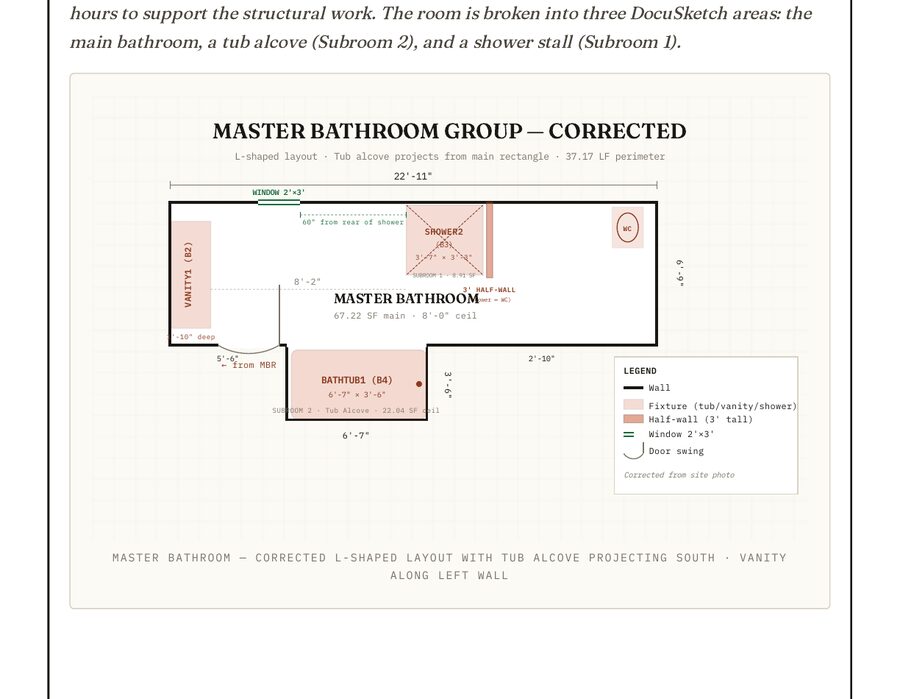
1 · Subfloor Replacement
One 4×8 sheet is only 32 SF. The estimate-scoped subfloor area is 67.22 SF — two sheets gives 64 SF before any cuts. Buy 3 sheets to match the actual scoped area, not the owner-list's "1 sheet" figure.
Accessories: premium polyurethane subfloor adhesive (3–4 tubes), 2-1/2" subfloor/deck screws (5 lb box). OSB T&G (e.g., Huber AdvanTech 23/32") is acceptable substitute; estimate specifies plywood.
2 · Joist / Structural Coordination
Field demo will reveal actual rot extent. Estimate scoped a localized repair; if more joist is rotten, supplement before buying additional lumber.
Insulation (estimate Line 25): 102.33 SF of 4" R-11 batt, paper/foil faced. Spec is thin for modern code — R-13 or R-15 is more typical for 2x4 walls. Match existing or upgrade.
3 · Drywall + Flood Cut
Classic water-damage cut pattern: full wall section behind tub/shower (96 SF) plus base-of-wall cut along the rest of the room (14.92 LF up-to-2' tall).
Do not use regular drywall inside the shower enclosure itself — use cement board + waterproof membrane (see Project 5 below). Moisture-resistant drywall (greenboard) is acceptable for the non-wet walls.
4 · Floor Tile
Good-enough-to-sell: neutral 12×24 porcelain from Floor & Decor, Lowe's, or Home Depot. Avoid highly personal colors.
Style note: estimate's 37.17 LF tile base exactly matches main bathroom floor perimeter — buy matching tile base trim, not separate baseboard.
5 · Shower / Tub Wet Area
Liquid waterproof membrane (e.g., RedGard or Laticrete Hydro Ban–style) over cement board is the modern correct method — already specced in the estimate. Tape seams with fiberglass mesh and polymer-modified thinset before applying membrane.
6 · 54×36 Double-Threshold Shower Base
Three budget-friendly options to evaluate (verify availability and current price before purchase — these are market-research starting points, not estimate data):
- DreamLine SlimLine 54×36 Double Threshold — industry standard, 2.75" threshold, SlipGrip floor, left/right drain
- OVE Decors Adena 54×36 — reversible hidden trench drain, flexible if plumbing rough-in needs adjustment
- KPUY / EASYWORC 54×36 — lowest-cost option set, verify flange layout
Set the base into a fresh mortar bed (not directly on subfloor) — fills voids between subfloor and structural ribs, eliminates deflection and acoustic resonance, prevents stress fractures.
7 · Finished Waterproof Wall Panels
This is the owner-added "finished wall coverage" over the cement board / membrane substrate. Estimate already covers 160 SF of cement board + membrane (Project 5 above); this is the finish layer on top.
Options ranked by cost & sell-readiness:
- Cheapest: Glue-up shower wall panels (composite, no grout)
- Better: Solid surface wall panels
- Best resale: Porcelain tile over the existing scoped cement board + membrane
Accessories: tub/shower surround adhesive (3–5 tubes), 100% silicone bath sealant (2–4 tubes), inside-corner / end-cap trim per panel system.
8 · Glass Shower Enclosure
Do not order until the base and finished wall system are installed or field-verified. Glass tolerances are unforgiving — even a 1/4" deviation will cause a custom recut or chronic leakage.
Budget-friendly alternatives to evaluate (under estimate's $3,482 line for full custom):
- Framed/semi-framed sliding door (cheapest practical path)
- Kobiworks Radiance sliding frameless (stainless/brass hardware)
- Glass Warehouse pivot frameless or Aston Avalux hinged corner
Glass spec: ANSI-certified tempered safety glass, 1/4" to 3/8" (10mm).
9 · Vanity / Top / Sinks / Faucets / Plumbing
Vanity sizing — estimate target is 81" (6.75 LF). Practical retail options:
- 78" — safest fit, leaves filler/trim space
- 80" — best likely match without field measurement
- 84" — only if wall clearances allow; field-measure first
- Two 36" vanities + filler — flexible budget option (72" + filler)
Recommended retail-grade lines: Wyndham Collection Beckett or Avery (72" double, plywood/solid wood core, cultured marble integrated top, dovetail soft-close drawers). Faucets: 4" centerset or 8" widespread depending on top drilling — ceramic disc cartridge (Pfister Karci, Delta Lorain/Downing).
Mirror: estimate scopes 20.25 SF 1/4" plate glass — reuse existing or replace with framed mirrors.
10 · Paint Master Bathroom
Bathroom paint sheen is non-negotiable: satin or semi-gloss. Flat paint in a wet room is asking for problems — higher gloss = tighter resin structure = better moisture and vapor resistance.
Accessories: paintable acrylic-latex caulk (1–2 tubes).
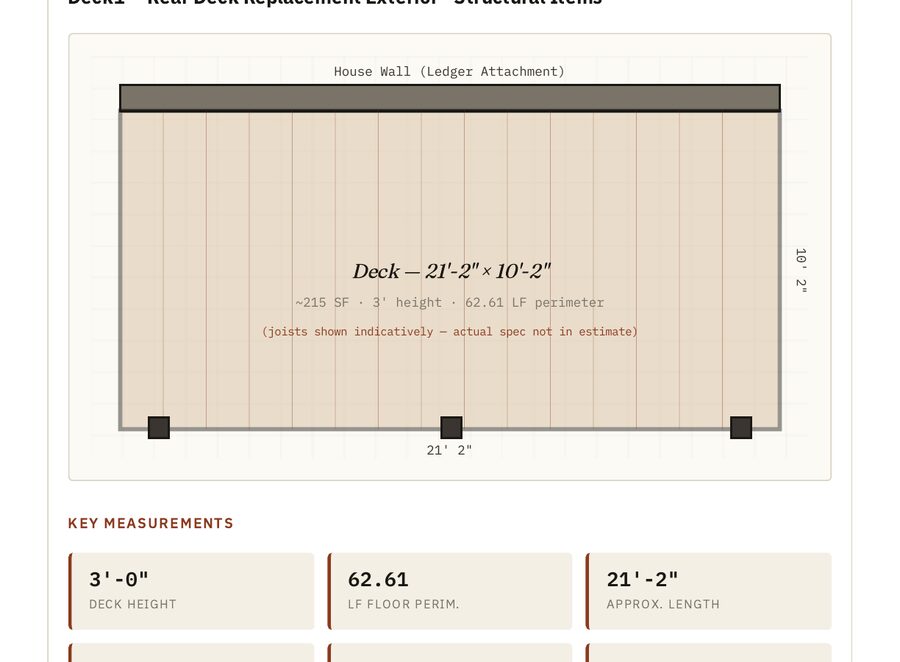
1 · Replace 25% Surface Boards
Board math: 5/4" × 6" deck boards are nominally 6" wide but actual 5.5", so each LF = ~0.458 SF. 60 SF / 0.458 = ~131 LF needed.
- 12 ft boards: 11 boards (132 LF)
- 16 ft boards: 9 boards (144 LF) — fewer butt joints, recommended for the 21'-2" span
Spec: 5/4" × 6" × 12' or 16' pressure-treated #1 grade, kiln-dried, Ground Contact preservative (micronized copper azole). Cline Lumber (Marietta) carries 16' PT yellow pine ~$12.50/board; Home Depot WeatherShield Premium ~$15–17/board.
Accessories: hot-dipped galvanized or polymer-coated deck screws (modern PT's copper content corrodes standard steel via galvanic reaction). Joist tape (butyl) strongly recommended over exposed joists.
Do not cover rotten framing with new boards. Inspect joists/ledger first — see Project 3.
2 · Under-Deck Gravel
Bulk delivery is the only practical procurement — 1.33 CY = ~1.6–1.8 tons. Retail bagging (~72 bags at 0.5 CF each) is prohibitively expensive and labor-intensive.
Cobb County bulk suppliers (#57 stone):
- Cummin Landscape Supply — $68–99/CY
- Georgia Landscape Supply — $84/ton
- Mountain High Mulch — $85/ton
Why #57 stone (not pea gravel): angular crushed granite interlocks when compacted — rigid, stable, won't shift or wash out. Pea gravel's rounded edges allow constant shifting.
Accessories: commercial-grade woven geotextile weed barrier under the gravel — prevents stones sinking into mud, halts upward weed migration.
3 · Structural Inspection (Underside)
This is the most safety-critical gap in the estimate. Per CPSC, deck collapses most commonly originate at ledger detachment. Water intrusion (the loss event here) is a leading cause of ledger/joist rot. The 16 HR allowance (~$2,247) is enough labor for moderate repairs but no materials are scoped.
Standard residential practice for a 3'-tall, 21'-2" × 10'-2" deck (field-verify each):
- Ledger: 2×10 or 2×8 PT, full length of house-side, 1/2" lag bolts or LedgerLOK/TimberLOK staggered 16" OC, with 2" spacer/stand-off if continuous flashing isn't present
- Ledger flashing: Z-flashing or self-adhering membrane between siding and ledger — frequently missing on older decks, primary cause of water-driven rot
- Joists: 2×8 or 2×10 PT, 16" OC, ~14 joists across the 10'-2" span
- Outer beam: doubled or tripled 2×8/2×10 PT
- Posts: 4×4 (older) or 6×6 (current code preference) PT, ~3 along outer edge
- Footings: 12" diameter concrete piers, below frost line (~12" in N. GA)
- Hardware: Simpson LUS hangers at every joist-to-ledger connection, plus IRC R507.9.2 lateral hold-downs (Simpson DTT2Z) at minimum 2 ledger locations
Before authorizing the framer hours, request: (1) photos of existing ledger attachment, joist sizes, posts, footings during demo; (2) marked-up sketch identifying rotten members; (3) per-EA contingency line for joist replacement + lateral load connectors.
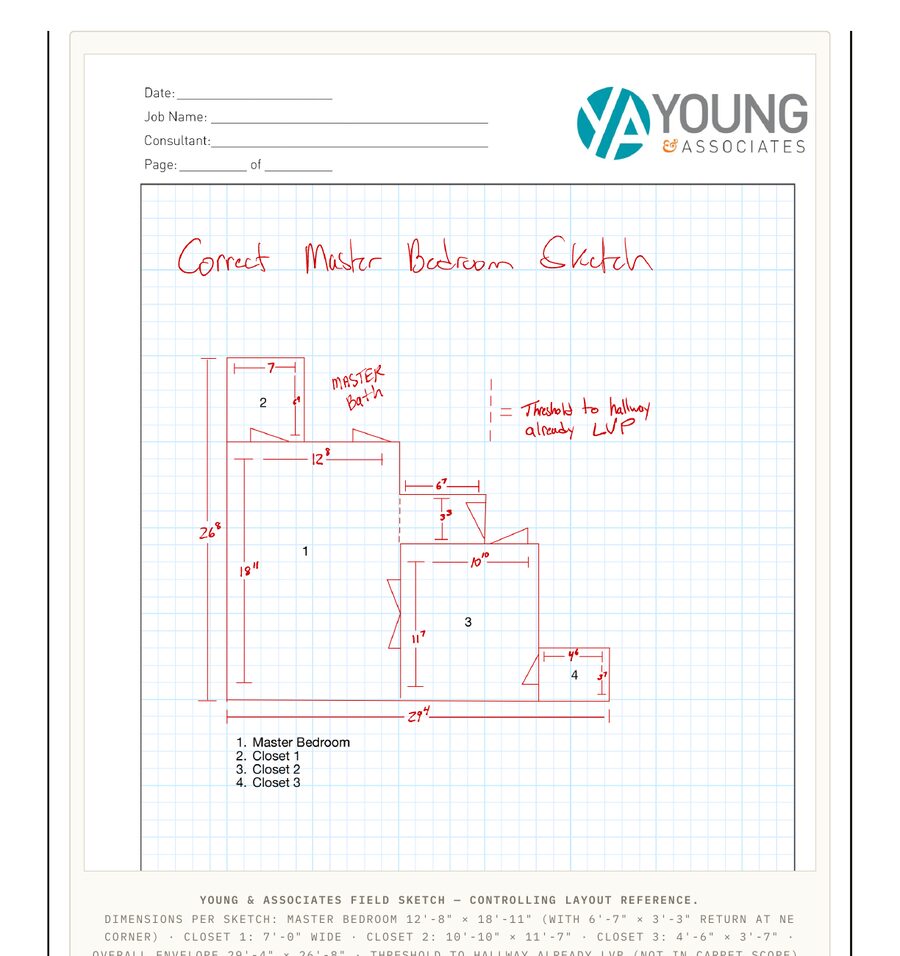
1 · Carpet + Pad — Full Suite
Carpet replacement is uniform across all four spaces. Estimate scoped "Standard grade" pad and unspecified carpet face weight/fiber/style.
Carpet grade verification — if the pre-loss carpet was plush, frieze, or higher-grade Berber, the "standard grade" replacement line is a builder-grade downgrade. Document existing carpet with photos & retained samples before authorizing.
Pad upgrade: estimate is "Standard" — if staying in house long-term, upgrade to 8 lb rebonded polyurethane pad. For sale-prep, match estimate.
Fiber options:
- BCF Nylon — best for high-traffic, springs back after compression
- Polyester — better innate stain resistance, but mats permanently in walkways
Threshold note: hallway entry threshold is already LVP — confirm installer terminates new carpet cleanly at the LVP transition.
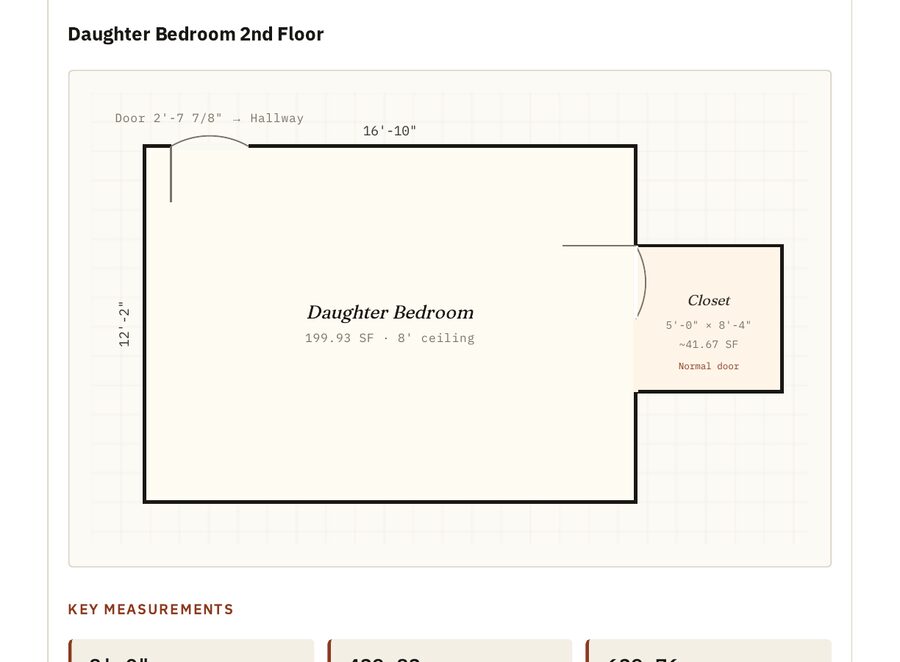
1 · Carpet + Pad
Closet inclusion uncertainty: Bedroom main floor at 16'-10" × 12'-2" = 204.85 SF. Estimate's 199.93 SF pad is within ~2.5% of main-room-only, suggesting the 5'-0" × 8'-4" closet (~41.67 SF) may not be included. If closet carpet needs replacement, add ~42 SF pad + ~48 SF carpet to the order — about 21% above the estimate quantity.
Carpet grade verification — match existing fiber/style if pre-loss was above builder-grade. Document with photos before authorizing "Standard grade."
Pad upgrade: stick with estimate for sale-prep; only upgrade to 8 lb rebonded if staying long-term.
1 · Carpet + Pad
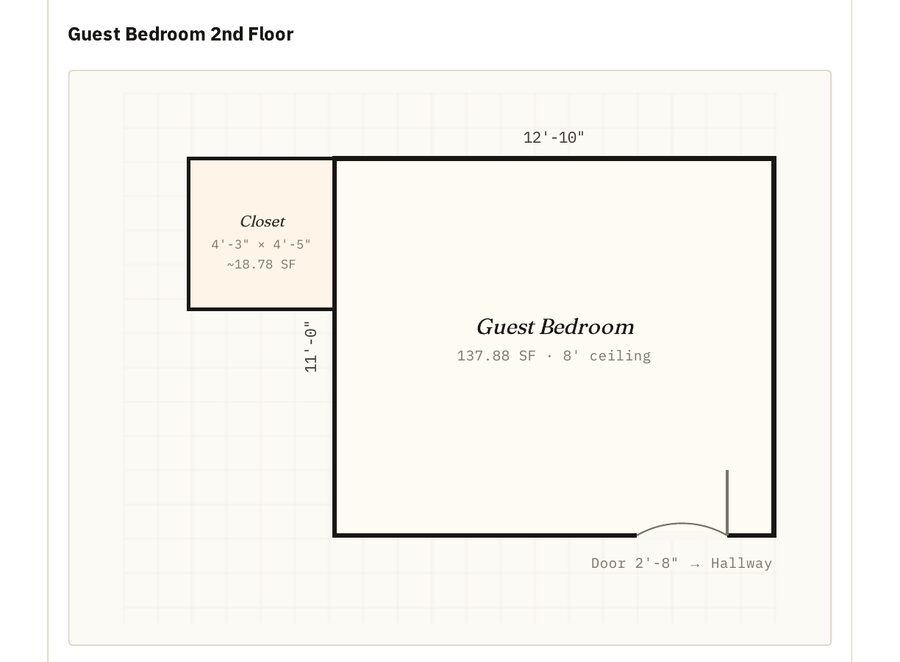
Closet inclusion uncertainty (same pattern as Daughter BR): Bedroom main floor at 12'-10" × 11'-0" = 141.17 SF. Estimate's 137.88 SF is within ~2.3% of main-room-only — closet (~18.78 SF) likely excluded. If closet carpet needs replacement, add ~19 SF pad + ~22 SF carpet.
No door D&R in estimate. Daughter Bedroom (Line 75) and Office both include 1 EA door D&R — Guest BR does not. Minor labor item; either pop the door yourself before install or supplement the estimate.
Match carpet style/fiber across Daughter BR, Guest BR, and Office for visual continuity on the 2nd floor. Single dye lot if ordering together.
1 · Carpet + Pad
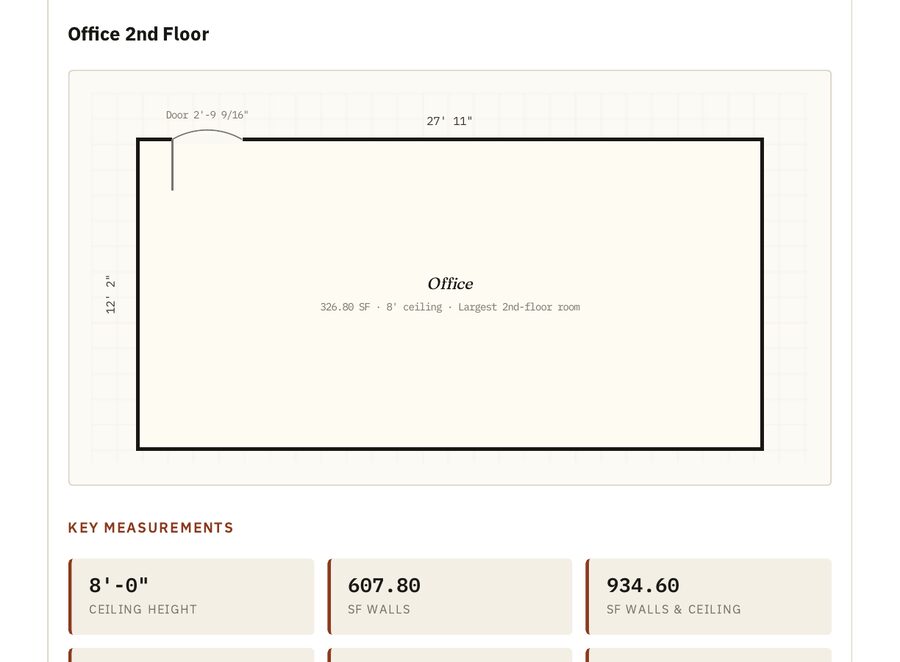
Largest 2nd-floor carpet zone — bundle ordering with Daughter BR + Guest BR for single-dye-lot consistency across the upper floor.
Estimate's 326.80 SF pad is within 4% of the 339.62 SF total room — matches main floor minus a small closet allowance. Office floor scope is clearer than the two bedrooms.
2 · Paint Office Walls + Ceiling
Not in the estimate. This is the owner-added refresh on the largest 2nd-floor room. Painting at the same time as carpet replacement (drop cloths over new pad before stretch) saves labor on cut-in at the base.
Sheen for office walls: eggshell or low-sheen (touch-up tolerance, scrubbable but doesn't flash like satin under direct light). Ceiling: flat ceiling white, not the same gallon as the walls.
Wall color decision pending. Hold the buy until color/sheen is locked — re-stocking gallon paint is painful and tinted gallons are non-returnable at most retailers.
Accessories: paintable acrylic-latex caulk (1–2 tubes for trim/casing gaps), 1 gal PVA primer if any patching or sheen-changes from prior coat.
1 · Ceiling Drywall — Nail Pop Repair
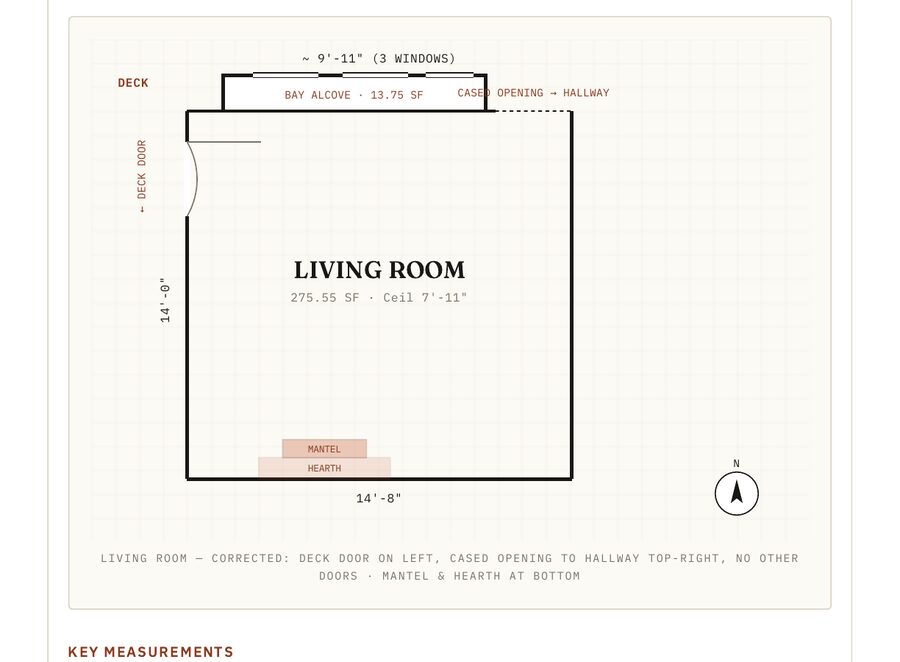
Nail pops are typically refastened with drywall screws (not replaced board) — the 4 HR allowance fits that level of repair. Hold 2 sheets in reserve in case any section needs full cut-out.
Bundle with Project 2 (wall drywall) for a combined 3-sheet purchase — see Project 2 recommended purchase.
2 · Wall Drywall Patch
Three sheets is the efficient bundle — 2 for ceiling spot replacement, 1 for the wall patch, with offcut available for the small Kitchen Ceiling patch (Tab 9). Single trip, single delivery.
Accessories: 1 roll paper drywall tape, 1 box/bucket all-purpose joint compound (5 gal), 1 box 1-5/8" coarse-thread drywall screws, 1 gal PVA primer.
3 · Paint Walls + Ceiling
Estimate's 760.59 SF is a combined figure (Line 4) — the owner shopping list needs to split it back into wall vs ceiling gallons since the products differ.
Sheen: eggshell or matte for walls, flat for ceiling. Match across Office (Tab 7) for visual continuity if open sight-lines connect the rooms.
Color/sheen pending. Hold the gallon buy until locked — tinted gallons are non-returnable at most retailers.
Accessories: 1 gal PVA primer for drywall patches (Projects 1 + 2), paintable acrylic-latex caulk (2 tubes for casing/baseboard gaps).
4 · Casing
Match existing casing profile — bring a 6"–12" sample to the lumberyard before buying. Common profiles: colonial, ranch, craftsman flat. Stain-grade vs paint-grade matters for the matching.
Accessories: 6d–8d finish nails (or 2" brad nailer cartridge), paintable acrylic-latex caulk (1 tube), wood filler for nail-set holes.
5 · Ceiling Fan + Light D&R
No purchase — labor only. Existing fixture preserved. If the fixture needs replacement (dated, dirty, undersized for the room), that's an owner-added line, not part of this estimate.
1 · Kitchen Ceiling Drywall Patch
Too small to merit its own sheet — comes off the Living Room offcut. No incremental drywall purchase.
Accessories: shares Living Room's tape, mud, screws, PVA primer.
2 · Paint Kitchen Ceiling
Measure first. Kitchen ceiling SF is not on file. Step the ceiling perimeter with a tape before ordering.
Kitchen ceiling paint should be scrubbable matte or eggshell, not pure flat — kitchens collect grease aerosol that's impossible to remove from flat ceiling paint. Premium product (e.g., scuff-resistant matte) is worth it for the small area.
Match white tone to Living Room ceiling (Tab 8 · Project 3) if there's any open sight-line between the rooms.
1 · Ceiling Drywall Patch + Repaint
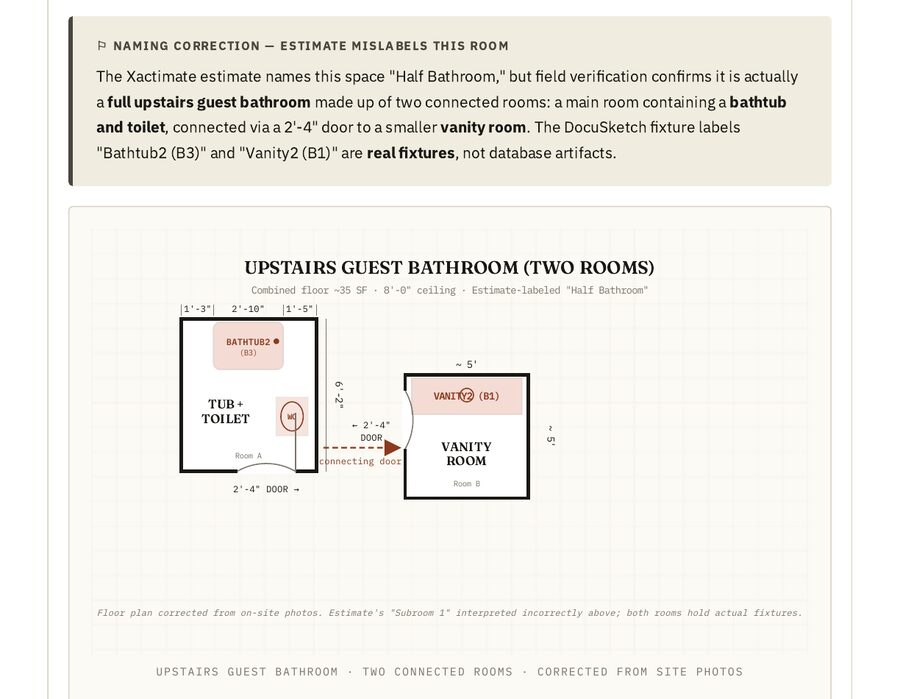
Smallest single-project room in the estimate. Materials come off the Living Room/Kitchen drywall + primer stockpile — no incremental retail purchase needed beyond a small can of matching ceiling paint (or use the Kitchen Ceiling gallon for both, since both are scrubbable matte/eggshell ceiling white).
Texture-match note: "heavy hand texture" is the estimator's call from the field. If existing ceiling is knockdown or popcorn, the texture method is different (knockdown needs a roller + knock-knife; popcorn needs a hopper gun). Inspect before patching.
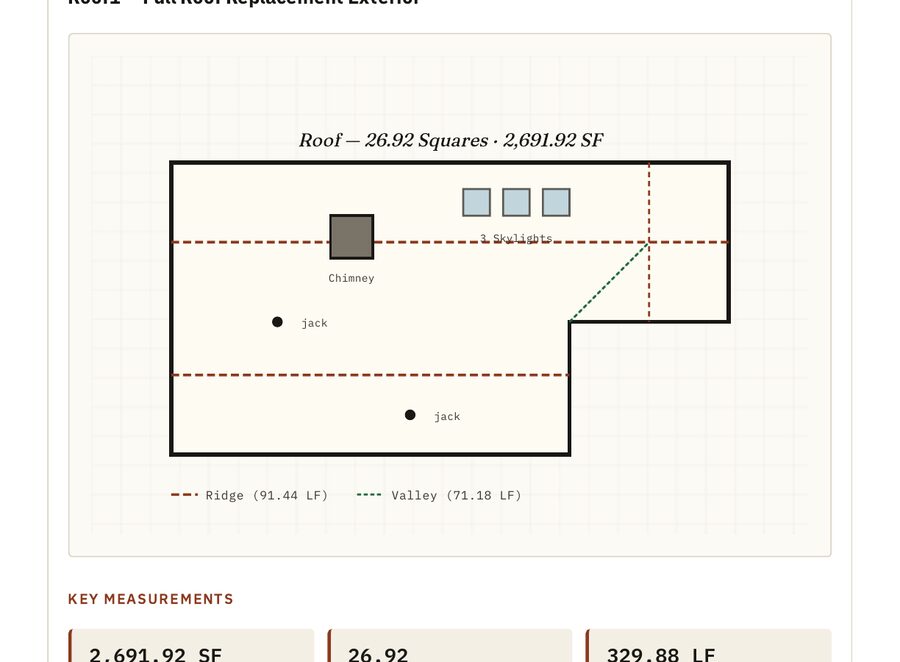
1 · Roof Replacement
Shingle-type verification before authorizing. Estimate specs "3-tab 25 yr" — most Marietta homes of this vintage carry architectural / dimensional shingles (30 yr+). If existing is architectural, the line item is a builder-grade downgrade — request like-kind upgrade ($30–50 more per SQ installed).
Missing line items to push for:
- Sheathing replacement allowance (per-sheet contingency for rotten decking found at tear-off)
- Ice & water shield at eaves & valleys (current IRC best practice, esp. in Cobb's ice-storm zone)
- Synthetic underlayment (vs felt) — better tear resistance, longer dry-in tolerance
The 2.75 SQ delta between tear-off (26.92) and install (29.67) likely accounts for hip/valley/starter waste — verify with the roofer.
Do not order materials independently — roofing is contractor-supplied. The estimate is the reimbursement basis; the actual contract will be roofer-to-owner.
2 · Exterior Surfaces — Targeted Paint + Siding Patch
This is a targeted repair, not a whole-house repaint. 737.29 SF is roughly 18% of total exterior wall area for a typical 2-story Marietta home. Owner-side scope creep is the risk: if the rest of the exterior is also chalking or peeling, a full repaint is an owner-funded decision, not estimate work.
Hardboard lap siding (Masonite/LP/etc.) — match the existing exposure (typically 6" or 7") and primer-back the patch before install. Modern fiber-cement (HardiePlank) is an upgrade if matching can't be sourced; expect more labor for paint matching.
Window sill (6 LF 2x4): water-rot symptom. Inspect adjacent framing during demo — if rot extends beyond the 6 LF, supplement before buying lumber.
Do not stage paint until siding patch + sill replacement + cleaning are complete. Surface prep is 80% of an exterior paint job's longevity.